Loading...
Serving Port Orange, FL and surrounding areas. (386) 400-1327
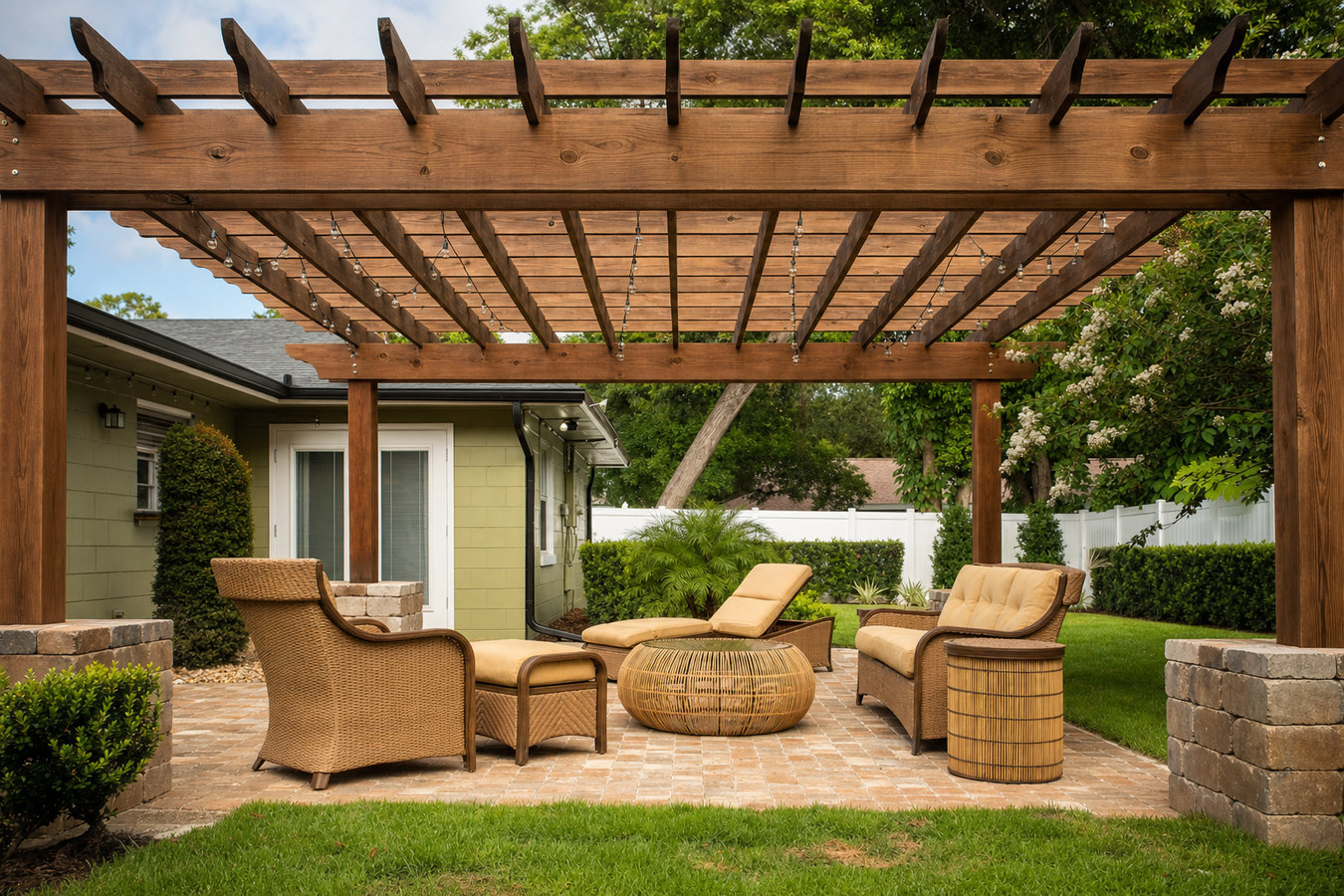
An open patio in Port Orange is nearly unusable by June. A properly built pergola gives your backyard a defined, shaded space you will actually spend time in.
Pergola installation in Port Orange creates a permanent open-beam or lattice-roofed outdoor structure, attached to your home or freestanding in your yard, and most straightforward projects wrap up in one to three construction days once the permit is approved.
If your backyard has a concrete slab or an existing deck that sits empty most of the summer, the problem is usually a lack of shade and no sense of enclosure. A pergola turns that empty slab into a defined outdoor room - a place to eat, relax, or have morning coffee that feels intentional rather than just an exposed patch of concrete you walk past. For homeowners who want full overhead coverage alongside the open-air frame, pairing a pergola with our covered deck and patio cover work is worth discussing before you commit to one design direction.
Every pergola we install in Port Orange is permitted through the City of Port Orange Building Division, anchored to account for the area's sandy soil, and built with hardware rated for Florida's humid, salt-air environment. The city inspector signs off before we call the job done.
If stepping outside in the afternoon means retreating almost immediately because of the heat, your outdoor space is not working for you. Port Orange summers are genuinely hard on exposed patios - direct sun on an uncovered slab can make the surface feel unbearable by midday. A pergola with a shade canopy or climbing plants can drop the perceived temperature enough to make your backyard livable through the months you would otherwise avoid it.
If you have an existing concrete slab or deck that sits empty most of the time, it is often because there is no shade or sense of place to make it feel like a destination. A pergola gives the space a defined purpose - it becomes a dining area, a lounge, or a place to sit with coffee - rather than just an empty surface you walk past. The enclosure alone changes how your family relates to the space.
If your backyard feels like an undifferentiated stretch of grass with no clear place to gather, a pergola creates that anchor point. This is especially common in newer Port Orange subdivisions where builders deliver a home with a plain concrete slab and no outdoor structure - the yard is functional but not inviting. A pergola gives it a reason to exist.
Port Orange buyers actively look for outdoor living features because of the year-round climate, and a well-built, permitted pergola is the kind of improvement that shows up clearly in listing photos and walkthroughs. If comparable homes in your neighborhood have outdoor structures and yours does not, a pergola is one of the faster ways to close that gap before going to market.
We build both attached and freestanding pergolas depending on your yard layout, your HOA rules, and how you plan to use the space. An attached pergola connects directly to your home's exterior wall or roofline and feels like a natural extension of the house - it tends to suit homeowners who want the covered space adjacent to a back door or sliding glass door. A freestanding pergola anchors to post footings in your yard and gives you more flexibility on placement - it works well over a pool deck, a garden area, or a spot away from the house entirely. For homeowners building a larger outdoor setup, combining a pergola with our outdoor kitchen deck creates a cohesive cooking and entertaining zone with overhead shade built in from the start.
Materials include pressure-treated pine, cedar, aluminum, and vinyl. In Port Orange's subtropical climate, aluminum and vinyl require the least ongoing maintenance and hold up best against humidity and salt air. Pressure-treated wood is a solid, cost-effective choice if you commit to sealing it every two to three years. We walk through the trade-offs on each material before you decide. All hardware we use is stainless steel or hot-dipped galvanized - standard steel corrodes fast in this environment.
Best for homeowners who want the covered space to feel like a direct extension of their home, connected to the back wall or roofline.
Best for homeowners who want the structure positioned away from the house - over a pool, garden, or yard area - with full post-footing anchoring.
Best for homeowners who want the open-beam look but need more sun and rain protection than a basic open-roof frame provides.
Best for homeowners who want to adjust light and airflow throughout the day, with motorized slats that close for full coverage or open for open-air feel.
Port Orange sits in a subtropical climate where summer temperatures regularly top 90 degrees and humidity stays high for months at a time. That combination is hard on outdoor materials and hard on homeowners trying to use their backyards. Many Port Orange homes were built during the city's rapid growth from the 1970s through the 1990s and delivered with plain concrete slabs and no overhead cover - the kind of yard that functions but does not invite you to spend time in it. A pergola changes that. Homeowners in New Smyrna Beach and Edgewater deal with similar subtropical conditions, but Port Orange's proximity to the Halifax River and the Atlantic coast adds salt air that accelerates corrosion on cheaper hardware - which is why material selection specific to this environment matters.
Port Orange's building permit process and HOA requirements also shape how pergola projects get done here. A significant number of Port Orange subdivisions - particularly those along the Spruce Creek corridor and near Dunlawton Avenue - are governed by homeowners associations with their own design and materials rules. Getting HOA approval before your contractor pulls a permit is the step that prevents costly changes or removal requests after the structure is built. The Florida Building Code also requires permanent outdoor structures like pergolas to meet wind-load standards - a requirement that is strictly enforced in Volusia County because of hurricane exposure. A permitted project means a city inspector has verified the anchoring, connections, and structural details before you use the space.
We will ask a few basic questions - where you want the pergola, roughly what size, what you plan to use it for, and whether you have an HOA. You do not need to have all the answers ready. Just describe what you are hoping for, and we will figure out the rest at the site visit. We reply within 1 business day.
We come to your property, measure the space, check the ground conditions, and talk through your options for materials and shade. A written estimate follows within a few days. It breaks out labor, materials, and permit fees as separate line items so you can see exactly what you are paying for.
Once you sign the contract, we submit the permit application to the City of Port Orange Building Division. This typically takes one to three weeks for approval. Nothing gets built until the permit is in hand - any contractor who wants to skip this step is not someone you want working on your property.
Most pergolas go up in one to three days. Posts are set first, then the beam and rafter structure builds up quickly. After construction, the city inspector visits to sign off on the work. We are present for the inspection and do a final cleanup and walkthrough with you before we leave.
We handle the permit, the HOA paperwork, and the install. Free on-site estimates with no pressure.
(386) 400-1327The City of Port Orange Building Division has its own permit review timeline and requirements. We handle the application, the drawings, and the inspection scheduling on every project - you do not have to navigate city building departments or figure out what forms to file.
Port Orange's sandy soil requires deeper footings or properly anchored surface mounts to keep posts from shifting over time. We specify the anchoring method based on your actual site conditions, not a general template. All hardware is stainless steel or hot-dipped galvanized - rated for coastal salt-air exposure.
We work regularly in Port Orange subdivisions with active HOAs, including communities along the Spruce Creek corridor and near Dunlawton Avenue. We review your HOA's architectural requirements before finalizing any design so you are not stuck with a structure your association requires you to change or remove.
Florida's building code requires permanent outdoor structures to meet specific wind-load standards - more demanding here than most other states because of hurricane exposure. Every pergola we build is designed and anchored to meet those requirements. The North American Deck and Railing Association's guidelines inform our structural approach on every project.
We have been building outdoor structures in the Port Orange area since 2016, and the combination of local permitting knowledge, soil-specific anchoring, and HOA familiarity means fewer surprises for you from first call to final inspection. Verify any Florida contractor license through the Florida DBPR license lookup tool before you hire anyone for pergola work in this area.
Combine a pergola with a full outdoor cooking setup - a built-out kitchen deck designed to carry the weight of appliances and stand up to Florida weather.
Learn MoreA solid-roof option for homeowners who want full protection from Port Orange's afternoon rain and intense summer sun, rather than the partial shade of an open-beam pergola.
Learn MoreFall and winter are the best time to build in Volusia County - call now to get your project on the schedule before the calendar fills up.